
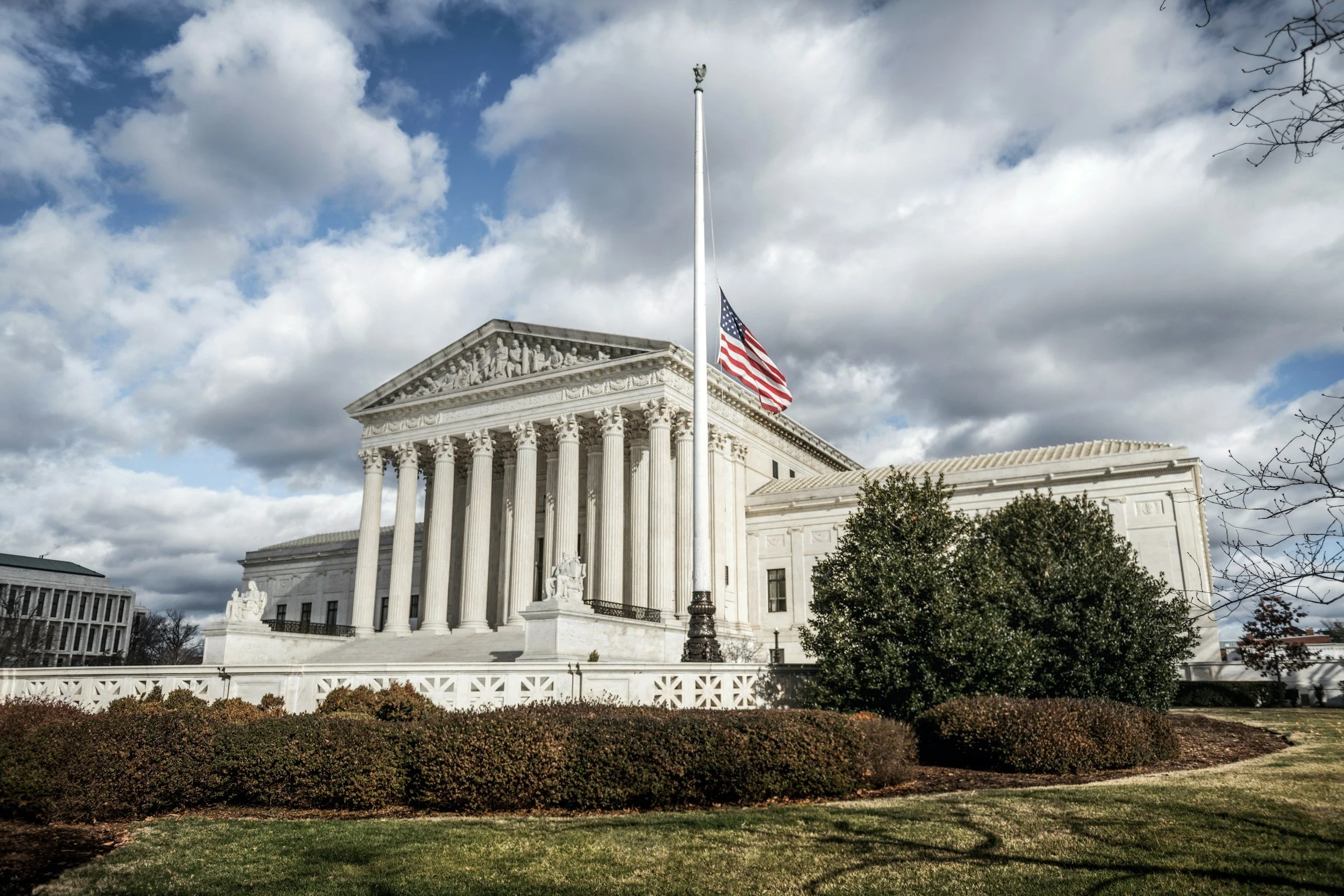
Free Speech Coalition at the Supreme Court
For decades, Free Speech Coalition has fought to protect freedom of expression and defend the constitutional rights of the adult entertainment industry.
FSC has been at the center of landmark Supreme Court cases addressing the First Amendment, online speech, and government regulation of sexually explicit content. These cases have helped shape the legal landscape for adult businesses, creators, and internet users across the United States.
Explore the cases below to learn about the legal challenges, Supreme Court decisions, and their lasting implications for free expression.
Ashcroft v. Free Speech Coalition (2002)
In 2002, the U.S. Supreme Court decided Ashcroft v. Free Speech Coalition, a landmark First Amendment case challenging portions of a controversial federal law that would have expanded the definition of child pornography to include material without actual children.
Because of rightful outrage over child exploitation material, the decision is often misunderstood or mischaracterized. We explain why FSC brought the challenge, what the Supreme Court decided, and how the ruling applies today.
What was Ashcroft v. Free Speech Coalition?
In 1996, Congress passed the Child Pornography Prevention Act (CPPA), expanding federal child pornography law beyond material created through the sexual abuse of actual children.
Among other things, the law criminalized any depiction that:
“is, or appears to be, of a minor engaging in sexually explicit conduct”
is presented in a way that “conveys the impression” that a minor was involved.
In other words, under CPPA, there didn’t need to be any minors, or even any sexually explicit conduct. It just needed to “appear” as if there were. It redefined the heinous crime of child pornography from a clear standard — actual minors engaged in sexually explicit conduct — to a vague, subjective one.
The point isn’t academic. Had CPPA stood, the producers of a show like Euphoria or Game of Thrones could have been prosecuted for distributing child pornography. So could a babyfaced college student sending sexts to their partner, or a 22-year-old adult performer, so long as a prosecutor felt they looked too young. And under CPPA, even possessing those images could result in criminal charges.
Why did FSC challenge the law?
A basic principle of the legal adult industry is that adult content is made by consenting adults, for adults. FSC did not object to the government’s authority to prohibit material created through the sexual abuse or exploitation of minors.
But the CPPA went further.
The phrase “appears to be” is highly subjective, and the definition of “sexually explicit conduct” included simulated acts. You didn’t have to be a child, or even be engaged in sex to be arrested. The law opened the door for overzealous prosecutors to bring child pornography charges based solely on their estimation of someone’s age, regardless of an actual government document.
FSC ultimately brought a constitutional challenge to these provisions, arguing that they were so broad that they prohibited expression protected by the First Amendment.
We challenged the law not because we thought it was right to portray minors having sex, but because we understood the potential for abuse. We understood how the law would not only be used to target legal adult content, but how it could be used to censor fictional works, art and mainstream films depicting youthful characters or sexuality. In its eventual decision, the Supreme Court pointed to films including American Beauty and Traffic while discussing the breadth of expression potentially affected by the law.
What did the Supreme Court decide?
In 2002, the Supreme Court struck down the challenged provisions of the CPPA as substantially overbroad and unconstitutional.
The Court distinguished between two categories:
Material involving actual children. The government may prohibit and prosecute material created through the sexual exploitation of real children.
Material created without an actual child. The government cannot automatically classify expression as child pornography simply because it appears to depict a minor when no actual child was involved in its creation.
In other words, the court found that while fictional depictions of minors engaged in sexual acts may be offensive, objectionable and even obscene, it is not the same as actual child pornography. The distinction was important because the Supreme Court’s earlier decisions allowing child pornography to be prohibited were based in significant part on the harm inflicted on children during its production.
What did Ashcroft NOT decide?
The ruling did not establish a right to sexually exploit children.
It did not invalidate laws prohibiting CSAM involving actual children.
And it did not make all fictional or computer-generated sexual material legal.
Fictional depictions of sexually explicit minors can be, and still are, prosecuted under federal obscenity laws. Ashcroft did not prevent prosecutors from bringing charges against egregious fictional or computer-generated depictions, and Congress later rewrote the law to allow for prosecutions of such depictions.
How does Ashcroft apply to AI-generated material?
When Ashcroft was decided in 2002, modern generative AI did not exist. The development of technology capable of producing highly realistic artificial images, potentially based on actual images, has raised new questions about how the principles established in Ashcroft apply today.
Those questions became particularly visible in the 2026 case United States v. Anderegg.
The case involved a defendant accused of using generative AI to create highly realistic sexual images depicting fictional children. He faced charges involving production, distribution and possession of the images, as well as transferring material to a minor.
A federal district court dismissed the possession charge while allowing the remaining charges to proceed. In August 2026, the Seventh Circuit Court of Appeals affirmed the dismissal, concluding that existing Supreme Court precedent constrained the government’s arguments concerning private possession of entirely virtual material.
FSC was not involved in Anderegg and did not advocate for the outcome. The case was decided nearly 25 years after Ashcroft and involves technology that did not exist in its current form when FSC brought its original challenge.
Judges on the Seventh Circuit also acknowledged the tension created by technological change. In a concurring opinion, two judges wrote separately to address how advances in generative AI have complicated the distinction between virtual and actual material established under existing Supreme Court precedent.
Does Ashcroft mean AI-generated CSAM cannot be prosecuted?
No. Ashcroft does not establish that all AI-generated sexual material is protected by the First Amendment. In fact, after Ashcroft, Congress passed the Protect Act of 2003, rewriting the statute to remove the vague “appears to be” language, specifying that depictions could still be prosecuted so long as they are “graphic.” FSC did not challenge this law.
In the Anderegg case, charges are still pending in regards to the production and distribution of the virtual content. The only issue addressed by the court was whether or not it could criminalize private possession of the virtual material.
Why does the distinction still matter?
FSC brought Ashcroft because Congress had written a law broad enough to potentially criminalize lawful sexual expression created entirely by adults.
The central First Amendment issue was not whether the government could prohibit the sexual exploitation of children. It was whether the government could expand that prohibition so broadly that it also criminalized protected expression.
Courts and lawmakers are now confronting how existing laws and constitutional principles apply to technology capable of creating increasingly realistic artificial images. While this was at least partially foreseen by the court in Ashcroft, new laws and new challenges will undoubtedly arise and the borders between what speech is legal and illegal could shift again.
Fighting for the rights enshrined in the First Amendment often means fighting on behalf of speech that we find disgusting, offensive, hateful or abhorrent. Such fights shouldn’t be read as an endorsement of said speech, but as a way to establish necessary limits on the government’s otherwise formidable power to censor.